


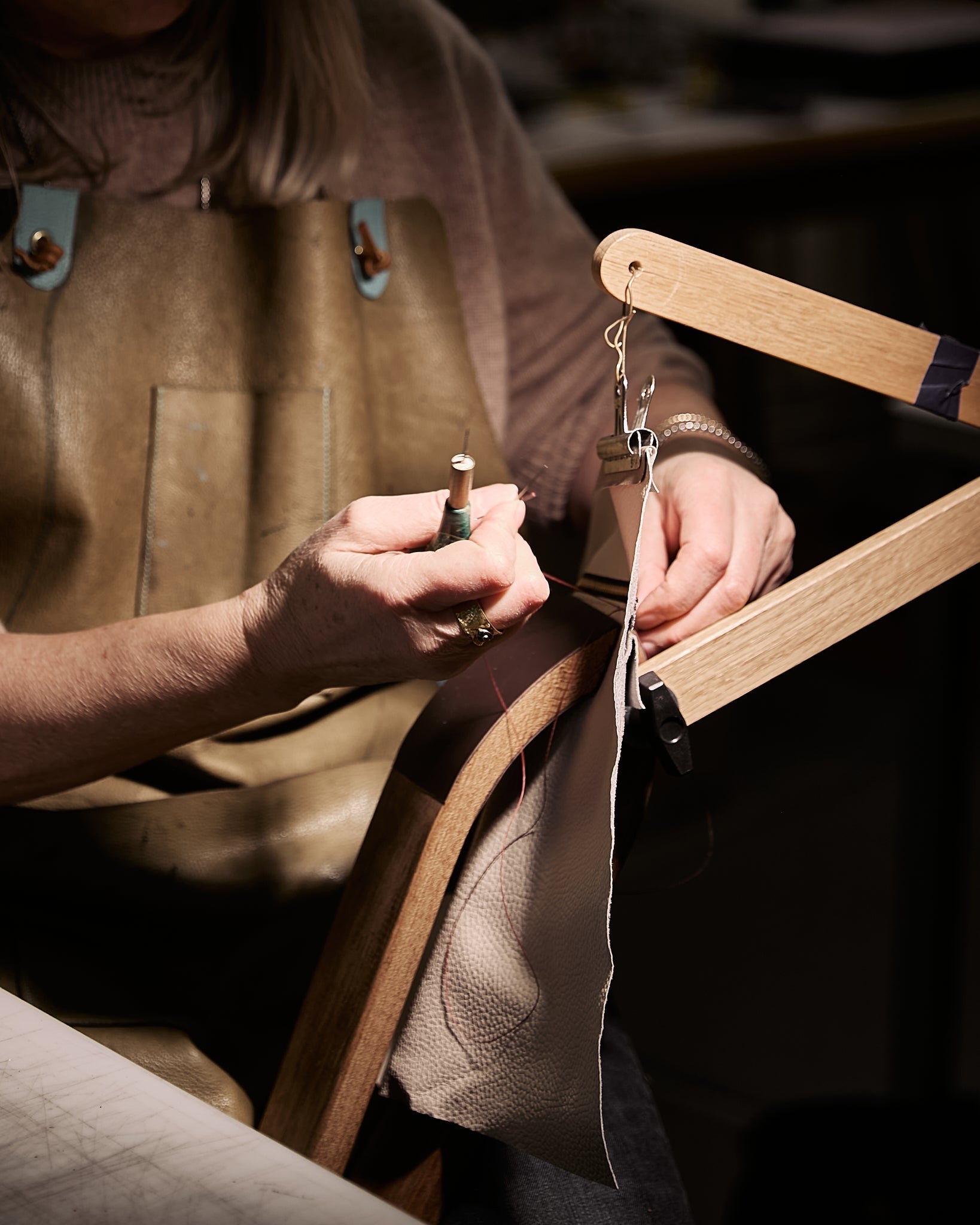
Our earlier post on the saddle stitch explained how it is made. This post answers the next question: what actually fails first, and why a hand-stitched piece outlasts a factory-stitched one by decades.
Two Failure Modes, Not One
A machine lockstitch and a hand saddle stitch look similar on the surface. They fail very differently.
A lockstitch has two threads. The top thread loops around a bobbin thread beneath the material. Tension between them is what holds the seam closed. Sever either thread, at any point, and the seam unzips. The two threads are structurally dependent on each other. When one goes, the other pulls free.
A saddle stitch has one continuous thread with a needle at each end. Each needle passes through the same hole from opposite sides. Every stitch locks independently on both sides of the leather. If a thread is cut between stitches, the surrounding stitches continue to hold. The seam does not propagate a failure.
This is the difference between a rope and a chain of knots. A rope fails at its weakest fiber. A chain of knots fails at one link and stops.
What Accelerates Wear
Three things wear a seam down: friction, tension cycling, and thread chemistry.
Machine stitching typically uses polyester thread that passes through a tension disc and a rotary hook. This introduces microscopic abrasion with every stitch formation. By the time a seam is sewn, the thread has already been stressed. Over years of use, that wear compounds.
We hand saddle stitch with waxed linen thread passed through a pricking-iron hole. No mechanical tension. The thread enters the leather in its original state. The beeswax compresses into the fibers and seats the stitch.
Tension cycling is where the structural difference shows up. A bag under load flexes at every seam. A lockstitch redistributes that load through both threads and the bobbin loop. A saddle stitch distributes the load across every independent stitch in the seam. No stitch carries more than its share.
What Happens at the Repair Bench
A damaged machine-stitched seam usually cannot be repaired in a way that restores the original. Restitching with a machine requires access to both sides of the material and a machine that matches the original tension and stitch length. Most repair shops cannot match factory parameters exactly. The visible result looks like a patch.
A damaged saddle stitch can be rebuilt. The artisan pulls out the affected section, matches the pricking iron to the existing hole pattern, and restitches in continuous linen. The repair is invisible to anyone not holding a loupe.
This is why Hermès will accept a forty-year-old Kelly bag back for repair and return it looking nearly new. The stitch is repairable. The object is not disposable.
What Changes in the Object
Thread settles. Over years, a hand saddle stitch actually tightens. The waxed linen compresses into the leather fibers around it. The stitches seat deeper. The seam becomes more structurally sound with age, not less. A well-made hand-stitched bag at twenty years is not a tired version of the original. It is a more settled one.
Machine stitching loosens. The polyester thread expands slightly under temperature cycling. Holes wear. Stitches migrate. By year ten, you can feel the difference running a finger along the seam.
What to Look For
If you want to see the difference in person, look at the stitch angle. A machine stitch sits perfectly vertical, every stitch identical. A saddle stitch has a gentle consistent diagonal, because two needles passing in opposite directions through the same hole naturally produce angled threads.
The thread on a saddle stitch also sits slightly raised off the leather surface. On a machine stitch, thread lies flat and uniform.
Once you see the difference, you cannot unsee it.
Learn the Stitch
Every class at Heirloom Leathercraft teaches the saddle stitch from the first session. In our two-hour workshops, you learn the fundamentals. In Level 1: Foundations and the Artisan Training Program, you develop it until it becomes the way your hand works.


