


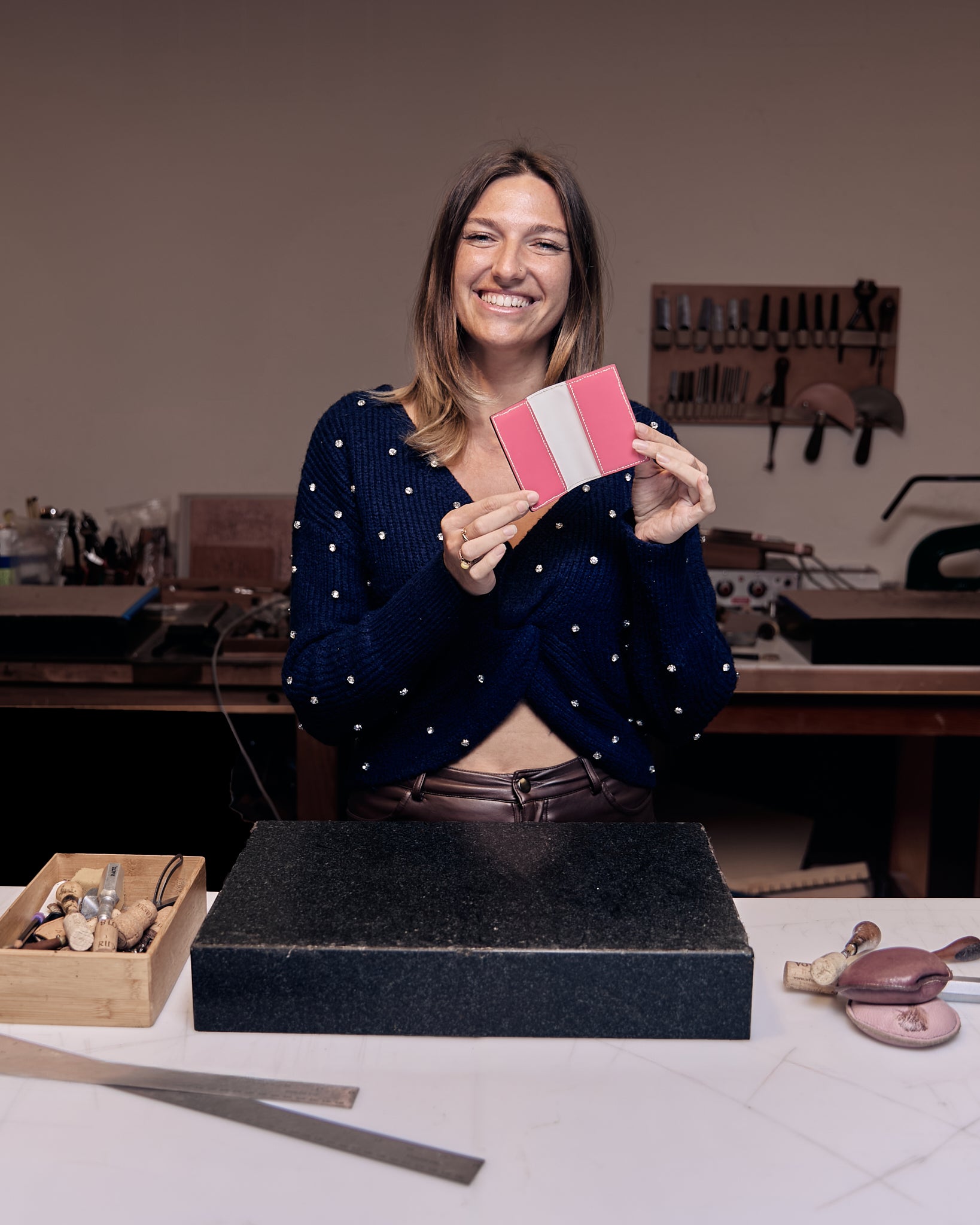
By the end of a year, the things you carry every day are things you created.
In a good leather class you make real, usable objects while learning the technique behind them, not disposable practice scraps. At Heirloom Leathercraft in San Francisco, a first year moves from small foundational pieces like card cases and pouches toward more structured goods as your saddle stitch and edge finishing improve. Each project is chosen to teach a specific skill. Level 1: Foundations is $5,000.
What do you actually walk out with?
Objects you use. The projects in a serious program are not throwaway exercises. They are real pieces, a card case, a pouch, a belt, a small bag, chosen because each one demands a skill worth owning.
The quiet reward comes months later, when the wallet in your pocket or the bag on your shoulder is one you cut, stitched, and finished yourself. That is a different relationship to an object than buying it.
It is a specific kind of satisfaction. The item is not only useful, it carries a memory of the hours you spent on it and the point where a particular skill finally clicked. Store-bought goods do not hold that, and it is the reason many students say the work changed how they see everything they own.
Why start with small pieces?
Because a small piece teaches a specific lesson without wasting a lot of leather. A card case teaches clean cutting, accurate hole spacing, and a tidy edge. A pouch adds a closure and a lining. Each project isolates a skill so you can get it right before combining it with others.
This is the logic of the Amblard Method. You finish one step to standard before the next begins, and the sequence of projects mirrors that discipline.
Small pieces also fail cheaply and quickly, which is a gift when you are learning. A crooked stitch line on a card case is a lesson you can absorb in an afternoon. The same mistake on a large bag costs far more leather and time, so the sequence protects both your budget and your morale.
How do the projects get harder?
Gradually and on purpose. Early work builds the base: the saddle stitch, straight cuts, even holes, sealed edges. Later projects add structure, corners, gussets, hardware, and lining, which ask more of your planning and precision.
By the time you reach a more complex piece, the fundamentals are habits rather than hurdles. The difficulty rises with your ability, which is what keeps the work rewarding instead of frustrating.
Do you learn technique or just assembly?
Technique, always. The object is the vehicle, not the point. Every project is an occasion to drill a transferable skill, so that when you finish the program you can plan and create pieces that were never on the syllabus.
Anne, a Fall 2025 graduate, described the arc: "Through this program, I loved learning by doing and refining my skills with each project. Watching my technique evolve from Level 1 to Level 4 was deeply rewarding, thanks to the high-quality teaching of Béatrice and Amélie. The program truly honors the discipline, precision, and tradition of fine leatherworking."
That is the difference between finishing a class and learning a skill. When the fundamentals are truly yours, the syllabus stops being a limit. You can look at a piece of leather and a picture in your head and close the distance between them on your own.
How is the first year structured?
It begins with Level 1: Foundations, priced at $5,000, which sets the core technique and habits you build everything else on. From there the core program continues through its four levels, each raising both the complexity of the objects and the standard of the finish.
Enrollment is open and rolling, so you can begin when you are ready and move at the pace that fits your life. There are no cohort deadlines.
How much can you really make in twelve months?
More than most people expect, and the growth is not only in quantity. The pieces you make late in the year are cleaner, more structured, and more confidently finished than the ones you started with, and you can see the difference laid side by side.
The point of a first year is not a full shelf of goods. It is to become someone who can keep making them, well, for as long as you want to.
Frequently Asked Questions
What do you make in a beginner leather class?
You make small, usable pieces such as a card case or pouch, chosen to teach specific skills like clean cutting, even spacing, and edge finishing.
Are the projects real items or practice scraps?
They are real, usable objects. The point is to learn transferable technique while making things you will actually carry.
What is the first course and what does it cost?
The first year begins with Level 1: Foundations, which is $5,000 and sets the base technique for the rest of the core program.
Do projects get more advanced over time?
Yes. Projects add structure, hardware, and lining as your fundamentals become habits, so the difficulty rises with your skill.


