


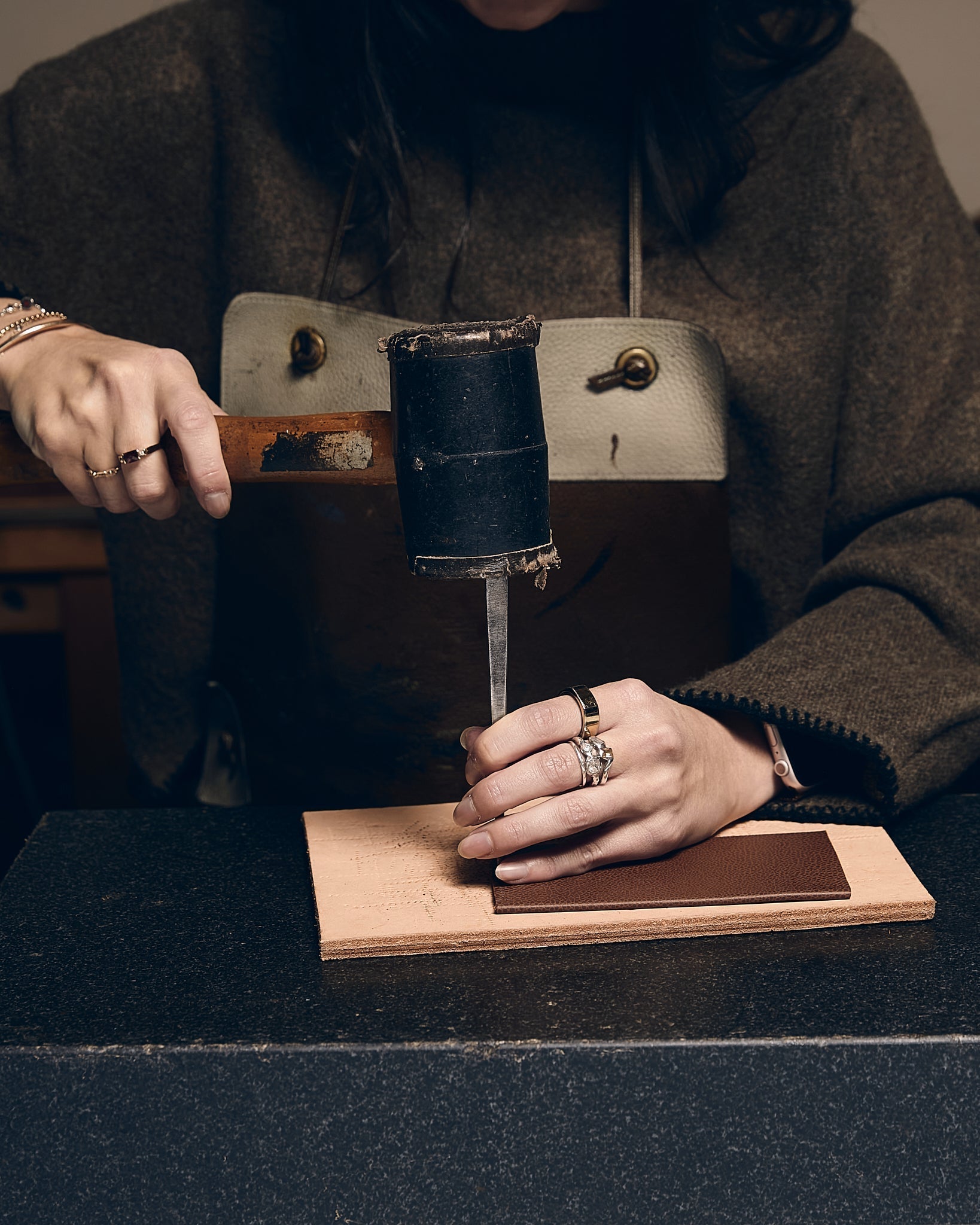
You can learn the stitch in a day. Becoming a maker takes longer, and it is worth naming honestly.
You can learn the saddle stitch in a single day. Building genuine, repeatable skill takes months of steady practice, and reaching a professional standard takes longer still. At Heirloom Leathercraft in San Francisco, the path runs from a one-day Introduction to a four-level core program, so you can go as far as you want at your own pace. Enrollment is open and rolling.
How fast can you make your first real thing?
In one day. The Introduction to the AMBLARD Method teaches the saddle stitch and sends you home with a piece you made yourself. That first object is where the intimidation drops away and the leather stops feeling like a mystery.
What you cannot do after one day is repeat that quality reliably across different projects. That is not a knock on a day well spent. It is simply the difference between a first success and a settled skill.
What does the honest timeline look like?
Think in stages rather than a finish line. A day gives you the stitch. A few months of regular practice gives you clean cuts, even marks, and edges you are not embarrassed by. A year of consistent work gives you the judgment to plan a project and carry it through without much hand-holding.
The variable that matters most is not talent. It is repetition with correction. Practicing the wrong motion for a month builds a habit you then have to unlearn, which is exactly what in-person teaching prevents.
It also helps to separate two things people blur together. Learning the technique is quick. Building fluency, the point where your hands do the right thing without conscious effort, is what takes time. Both are worth naming, because expecting fluency in a weekend is the fastest way to get discouraged.
How is the learning structured at Heirloom?
The core program is four levels, Level 1 through Level 4, and each level builds on the last. Level 1: Foundations is $5,000 and sets the base technique and habits. The later levels add complexity in the objects and precision in the standard.
For those who want to go deep quickly, the 12-week Artisan Training Program is full-time attendance at $20,000. Most people move through the levels at the pace that fits their life, because enrollment is rolling and there are no cohort deadlines.
None of the paths has a deadline attached. Because enrollment is open and rolling, you can take a level, live with what you learned, and return for the next one when it suits you. The timeline bends to your life rather than the other way around.
Why does in-person practice speed things up?
Leatherwork is physical knowledge. The right awl angle and thread tension live in the hands, and the hands learn them by doing, then being corrected, then doing again. Béatrice Amblard and Amélie Amblard teach at the bench so the correction comes early, while the motion is still forming.
This is why a student in a taught program tends to progress faster than one working alone from videos. The feedback loop is tighter, and fewer wrong habits set.
How do you know you are actually improving?
By looking at your own work over time. Anne, who graduated in Fall 2025, described exactly this: "Through this program, I loved learning by doing and refining my skills with each project. Watching my technique evolve from Level 1 to Level 4 was deeply rewarding, thanks to the high-quality teaching of Béatrice and Amélie. The program truly honors the discipline, precision, and tradition of fine leatherworking."
Progress in this craft is visible. Your stitch lines get straighter, your edges get cleaner, and the gap between what you picture and what you produce narrows.
How much should you practice between classes?
Consistency beats intensity. An hour or two of steady practice each week does more for your hands than a single long session every month, because the motions need frequent reinforcement to become automatic. Small, regular reps are what turn a taught technique into a reliable one.
This is also why many students set up a modest bench at home. Having tools within reach lowers the friction to practice, and lower friction is what keeps the habit alive between classes.
Is there a point where you are simply done?
Not really, and that is part of the appeal. Even after four levels, there is always a finer edge, a cleaner corner, a harder object. The craft rewards a lifetime of attention.
What changes is your relationship to it. Early on you are learning to create the item. Later you are refining it, which is a quieter and more durable kind of satisfaction.
Frequently Asked Questions
How long does it take to learn leatherworking basics?
You can learn the saddle stitch in a single day. Comfortable, repeatable basics generally take a few months of regular practice.
How long is the full program at Heirloom?
The core program runs across four levels at your own pace. The separate Artisan Training Program is a 12-week full-time attendance priced at $20,000.
Can I learn leatherworking on my own?
You can start alone, but in-person correction is what prevents wrong habits from setting and is the main reason taught students progress faster.
Do I have to finish one level before the next?
Yes, the four levels build in sequence, but you move through them at your own pace since enrollment is open and rolling.


