


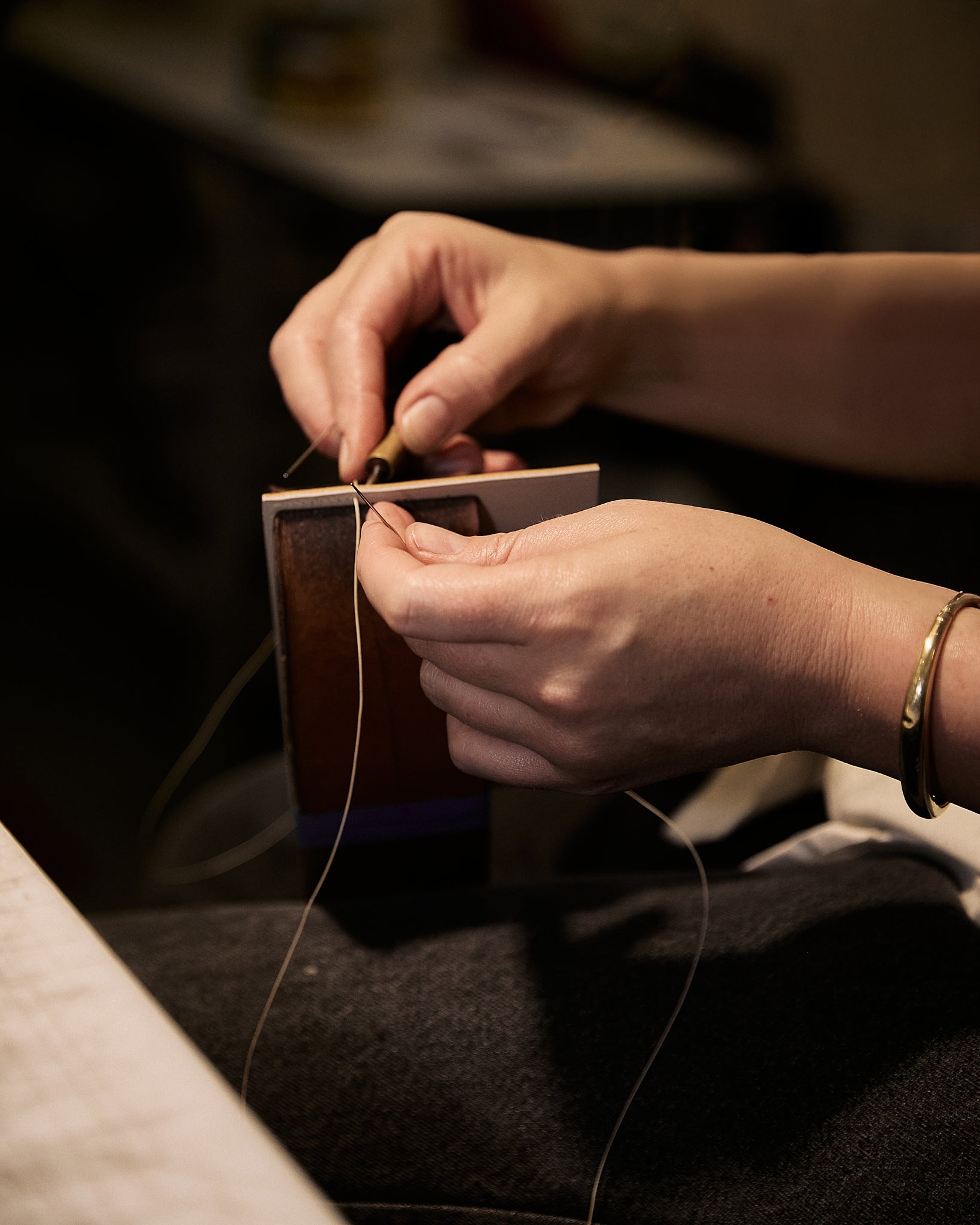
Every machine stitch shares a single vulnerability. One thread breaks, and the entire seam unravels. The saddle stitch does not work this way. It uses two needles and one continuous thread, each needle passing through the same hole from opposite sides. If one thread snaps, every stitch holds independently. The seam stays intact.
This is the foundation of everything we teach at Heirloom Leathercraft. It is also the technique that has defined the finest leather goods in the world for over two centuries.
How the Saddle Stitch Works
A machine lockstitch loops a top thread around a bobbin thread beneath the material. It is fast. It is efficient. It is also structurally fragile, because the two threads depend on each other. Cut one, and the other pulls free.
The saddle stitch takes a fundamentally different approach. The artisan uses a single length of linen or polyester thread with a needle at each end. An awl or pricking iron creates the holes. Then each needle passes through the same hole, one from the front and one from the back, creating an X pattern inside the leather. Every stitch is independent. Every stitch locks itself.
The result is a seam that actually gets stronger with age. As the thread settles into the leather, the fibers compress around it. The stitches tighten. A well-executed saddle stitch on quality leather will outlast the person who made it.
Where the Technique Comes From
The saddle stitch traces its lineage through the great European leather houses. At Hermès, where our founder Béatrice Amblard trained, every leather good is sewn by hand using this method. A single Kelly bag requires eighteen to twenty-four hours of hand stitching. The maison has used this technique since Thierry Hermès founded the company in 1837, originally making harnesses and saddles for the carriages of European nobility.
The name itself tells the story. This was the stitch used to make saddles, where failure meant a rider on the ground. The technique had to be indestructible. Two hundred years later, the standard has not changed.
Béatrice learned the saddle stitch at the Chambre Syndicale de la Couture Parisienne and refined it during her years at Hermès. She teaches it exactly as she learned it: with obsessive attention to thread tension, stitch angle, and consistency.
Why It Cannot Be Automated
Machines cannot replicate the saddle stitch. The reason is simple. A machine operates from one side of the material. The saddle stitch requires simultaneous access to both sides, with each needle guided by feel through the same hole. The artisan adjusts tension stitch by stitch, responding to variations in the leather, compensating for thickness changes at seams and edges.
This is why it remains a hand technique. Not out of nostalgia or marketing. Out of structural necessity.
What You Feel When You Learn It
Students in our workshops and Core Program learn the saddle stitch from their first session. The initial experience is humbling. The rhythm is unfamiliar. Your tension will be uneven. Your spacing will drift.
Then something shifts. Usually in the second or third hour, your hands begin to understand the motion before your mind processes it. The stitch becomes meditative. You stop thinking about the technique and start feeling the leather respond to it.
This is the moment Béatrice watches for. It is the point where a student stops performing a stitch and starts practicing a craft.
The Difference You Can See
Once you learn the saddle stitch, you cannot unsee the difference. Machine-stitched leather goods have perfectly uniform stitches that sit flat on the surface. Hand saddle-stitched goods have a subtle diagonal pattern, each stitch angled slightly by the natural motion of two needles passing in opposite directions.
Look at the stitching on a bag the next time you are in a store. If every stitch is identical and perfectly vertical, it was made by a machine. If there is a gentle, consistent slant, and the thread sits slightly raised from the leather, someone sat at a bench and sewed it by hand.
That distinction, once you know it, changes what you are willing to carry.
Learn the Saddle Stitch
Every class at Heirloom Leathercraft includes the saddle stitch. In our two-hour workshops ($175), you learn the fundamentals. In Level 1: Foundations ($5,000), you develop the technique across multiple projects until it becomes second nature. The stitch is the through-line of the entire curriculum, from first workshop through the 12-Week Artisan Training Program.
Béatrice teaches it the way she learned it. There are no shortcuts, and no substitutes.


