


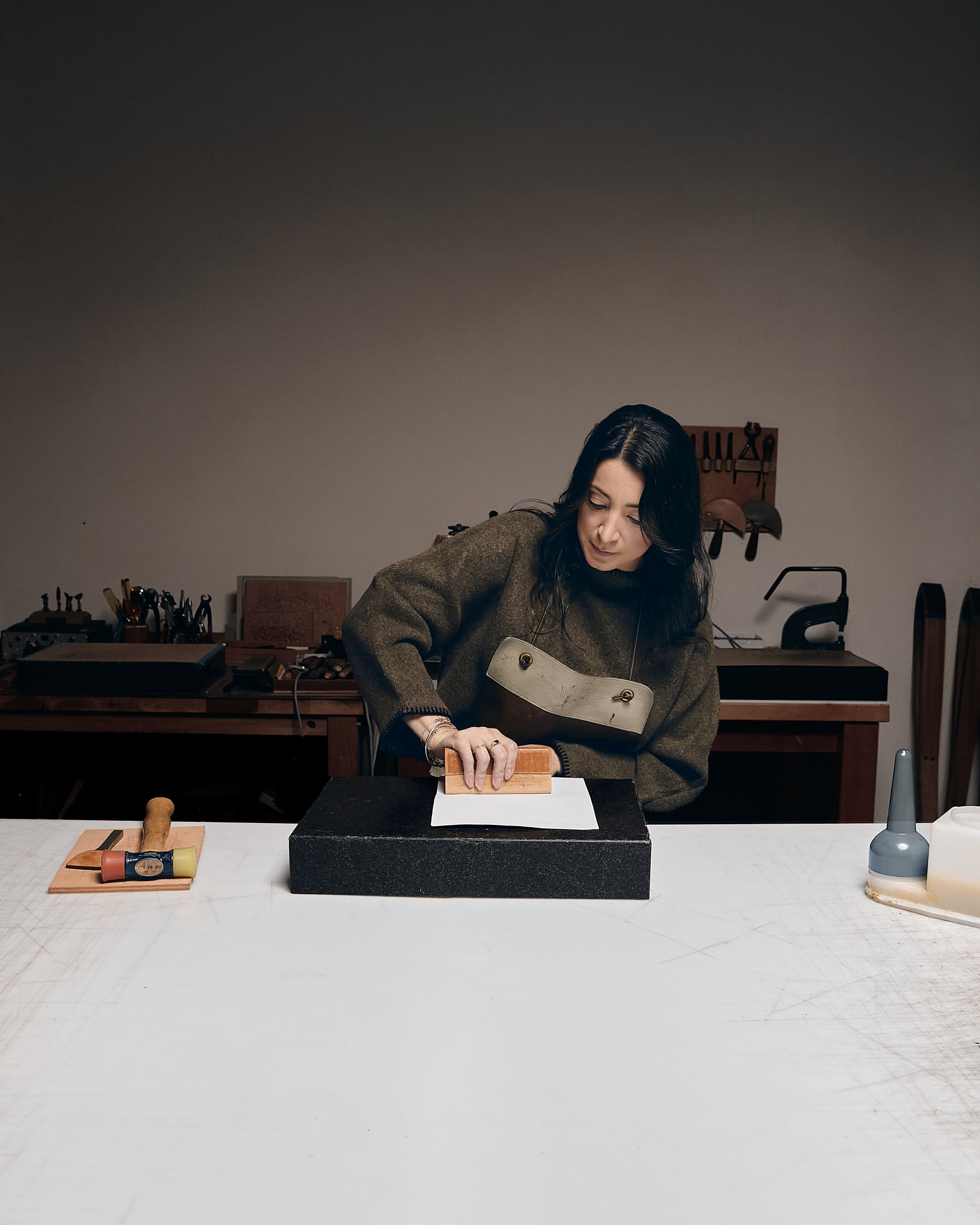
The Amblard Method is structured in levels. Each one builds on the last. The curriculum answers the same question at every stage: what does a trained hand actually need to know?
Here is what happens at each level, and what you leave with.
Introduction to the Amblard Method
One full day. $800. This is where most students begin.
You learn to read leather grain. You cut with a X-acto knife, which takes a different kind of control than scissors. You punch stitch holes with a pricking iron and hand-stitch with waxed linen thread. You leave with a finished piece and a clear sense of whether this craft is for you. No experience required.
The Intro is not a marketing product. It is a filter. Students who take the Intro and choose to continue have already decided the work matches their temperament. The ones who don't continue have saved themselves a larger commitment. Both outcomes are the right one.
Level 1: Foundations
Twelve sessions at the bench.
You start with pattern making. The architecture of every leather piece. Before you cut anything, you learn to plan. A pattern that is one millimeter off produces a piece that will never assemble cleanly. The habits formed here compound through every later level.
You move to the saddle stitch, building consistency and tension over hundreds of stitches. You learn edge finishing- sanding and burnishing. By the end of Level 1, you have completed six pieces including a cardholder, eyeglass case, zipper wallet, tray and you have the fundamentals to tackle more complex work.
Students who complete Level 1 can walk into most luxury ateliers and be understood. The vocabulary, the tools, the gestures, are the same vocabulary used in Paris and Florence.
Level 2: Intermediate Construction
The work turns three-dimensional.
More complex zipper installations. Gussets. Pieces with multiple panels that must align precisely or the piece fails. You learn to set hardware. To think structurally about how a bag holds its shape when it is empty and when it is full.
Level 2 is where students start to feel the shift from following instructions to executing decisions. You know the vocabulary. Now you are building sentences.
Level 3: Advanced Construction
Complex assemblies. Multi-compartment bags. Pieces that require planning across dozens of components.
The tolerances shrink. A seam that was acceptable in Level 2 is rejected in Level 3. The instruction becomes more demanding because your hand is capable of more. Students at this level begin developing their own design sensibility within the discipline of the method.
This is where pieces start to look like the work in a luxury boutique rather than a classroom project. Not because the instruction changes. Because your hands have caught up.
Level 4: Complex Construction
The final level. Large-scale projects. Portfolio-grade work.
Students at this level are producing pieces that could be sold professionally. The instruction becomes consultative. Béatrice and Amélie guide, rather than direct. You bring the questions. They bring the forty years of answers.
Level 4 graduates include people who now run their own ateliers. Some make bespoke pieces that sell for thousands. Others teach. A few have been featured in GQ and Esquire for the work they produce. The curriculum does not promise those outcomes. It equips the students who pursue them.
The Rolling Structure
Each level is available on a rolling basis. There is no fixed start date. When you finish one level, the next is open. You move at the pace the work demands of you.
The Artisan Training Program is 48 consecutive days that compress the equivalent of Levels 1 through 4 into an intensive. It is the right format for people who can commit the time and want the momentum.
Either path produces the same foundation. The difference is the rhythm.
Where to Start
If the craft is new to you, the Intro is the right entry point. One day. Real tools. Real leather. A finished piece in your hand by evening.


