


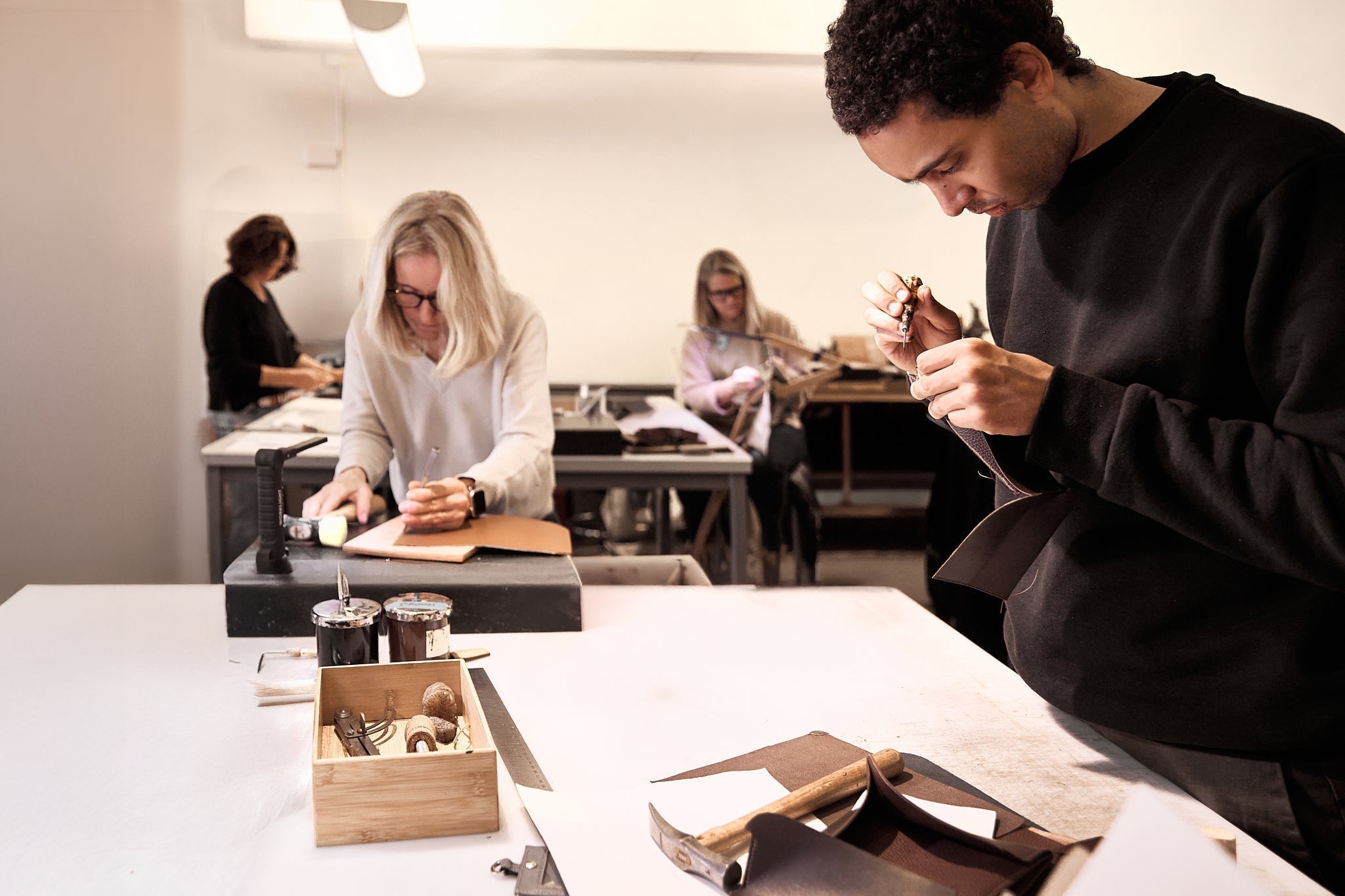
The Artisan Training Program is 48 days. That number raises the obvious question: what happens in those days?
The answer is not a syllabus. It is a rhythm.
You arrive at the atelier on Clement Street. You sit at a granite workbench with your own set of tools. The leather is already out. Béatrice or Amélie is already there.
Week One: Fundamentals
The first days are fundamentals. You learn to read grain direction. You learn to cut with a X-Acto knife, which takes a different kind of control than scissors. One blade through the hide, no compression. You learn to mark stitch lines with a pricking iron and to thread a saddler's needle with waxed linen.
Nothing moves quickly. That is intentional. The rest of the program depends on these first gestures being right.
Week Two: The Saddle Stitch
By week two, you are saddle stitching. Two needles, moving in opposite directions through the same hole. The stitch locks independently at every point. If one thread breaks, the rest hold. This is the engineering that makes a hand-stitched bag outlast a machine-stitched one by decades. (More on the saddle stitch, and why it still matters.)
You will pull thousands of stitches before the month is out. Your tension will be uneven at first. Then something shifts. Usually in the second or third hour of the second day, your hands begin to understand the motion before your mind processes it.
Week Three Through Four: Edges & Construction
By week three, you are beveling edges, burnishing them with heat, and starting to see what "finished" actually means in this craft. By week four, the work turns three-dimensional. Components that must align precisely or the piece fails. Flat work is a rehearsal. Real bags have geometry, and geometry is where the craft stops being about technique and starts being about judgment.
Weeks Five Through Seven: Your Own Work
You apply what you have learned to increasingly complex objects. Wallets. Card cases. Small bags. Then larger ones. Every project compounds on the last. By the end, you are not following instructions. You are executing decisions.
Week Eight: The Final Piece
By the end of 48 days, you have made multiple finished pieces. You have the technique to design and build your own. And you have a decision to make about what comes next.
The Amblard Method compresses a three-to-four-year apprenticeship into 48 days. Not by cutting corners. By cutting everything that is not the craft itself. There are no lectures. No theory segments. No busywork. Every hour is spent at the bench, with the tools, in the leather.
This is the format Béatrice built after four decades of leatherworking. She teaches in the traditional way and watches what actually transferred. What transferred was repetition, feedback, and the expectation that you would rise to the standard rather than the standard coming down to you.
What Comes Next
If this is the first you are hearing about the program, the lowest-cost way in is the Introduction to the Amblard Method: a single day at the bench, $800, with real tools and real leather.


