


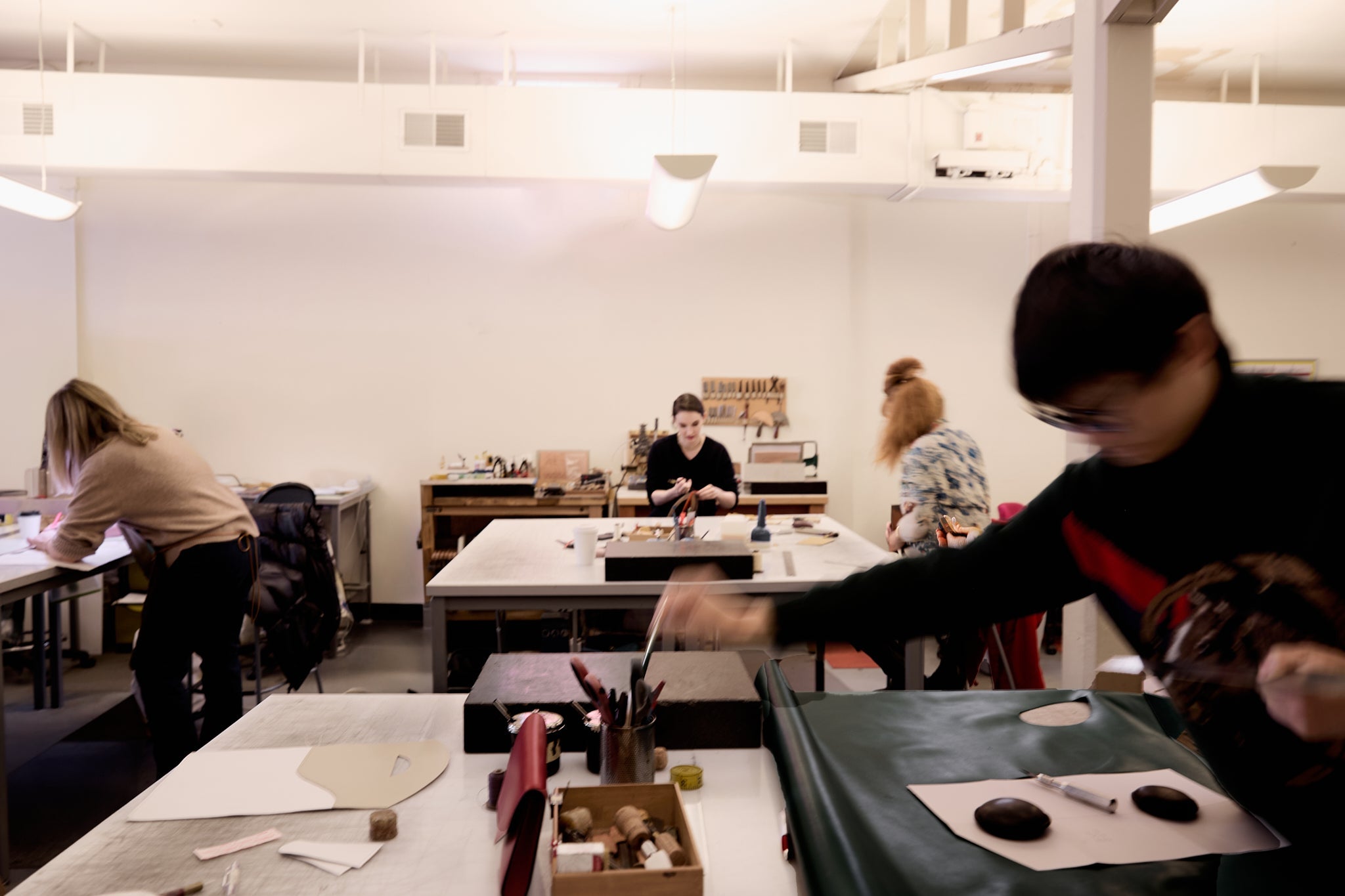
You have never worked with leather. You are not sure what to expect. By the end of two hours, you will have handled the tools of a tradition that predates industrial manufacturing, and you will understand, in your hands rather than in theory, why some objects last a lifetime.
Here is what your first session at Heirloom Leathercraft looks like.
You arrive at 15 Clement Street in San Francisco's Inner Richmond. The studio is inside April in Paris, the boutique Beatrice Amblard has run since 2012. The atelier is in the back. Workbenches, thread, awls, pricking irons, and full-grain leather are laid out for the session.
The Tools in Your Hands
In a two-hour workshop ($175), you work through one of two current sessions: Core Skills in Pattern Making & Minimum Waste Cutting, or a Seasonal Workshop where you create a Personalized Valet Tray.
The session starts with tool orientation. You learn the names and purposes of the hand tools used in traditional French leatherworking. These are the same tools Beatrice used at Hermes. They are not decorative. They are working instruments, and you will use them properly from minute one.
Then you move to technique. In the Pattern Making workshop, you learn to read a pattern, cut leather with minimal waste, and understand the relationship between design and material efficiency. In the Valet Tray session, you build a finished object from start to end.
The Saddle Stitch
The foundation of everything taught at Heirloom is the saddle stitch. Unlike a machine stitch, which uses a single thread locked by a bobbin, the saddle stitch uses two needles and one thread, each needle passing through the same hole from opposite sides. If one thread breaks, the remaining stitches hold. This is the technique used in Hermes leather goods. It is why those objects last decades.
You will practice this stitch repeatedly. Beatrice teaches it exactly as she learned it at the Chambre de Commerce de Paris and refined during her years at Hermes. The emphasis is on tension, consistency, and angle. It will feel unfamiliar. That is expected.
What Changes in You
This is the part most people do not anticipate. You walk in thinking about leather. You leave thinking about precision. The workshop does not just teach you a craft technique. It recalibrates your sense of what "done well" means. You will notice stitching on bags you pass in stores. You will see shortcuts you never saw before.
Whether this leads you to Level 1: Foundations ($5,000) or remains a single afternoon of focused work, the shift in perception is real.
What Happens After
Many students leave a workshop and continue. The next step is Level 1: Foundations ($5,000), which builds technique across multiple weekly sessions. There is also the Introduction to the AMBLARD Method ($800), a single-day intensive covering core principles in concentrated form.
You do not need to decide anything during the workshop. It exists to let you experience the craft and the teaching.
What You Will Not Find Here
This is not a craft night. The atmosphere is focused and professional. Beatrice teaches the way she works: with precision, without shortcuts. Students who thrive here want to learn a discipline.
That said, the community is warm. Graduates from 2012 still come to Open Studio sessions. Students become friends. The rigor and the warmth are not in tension.
Practical Details
All tools and materials provided. Wear comfortable clothing. 15 Clement Street, San Francisco, CA 94118. Street parking available. Muni serves the Inner Richmond. Book at heirloomleathercraft.com.


