


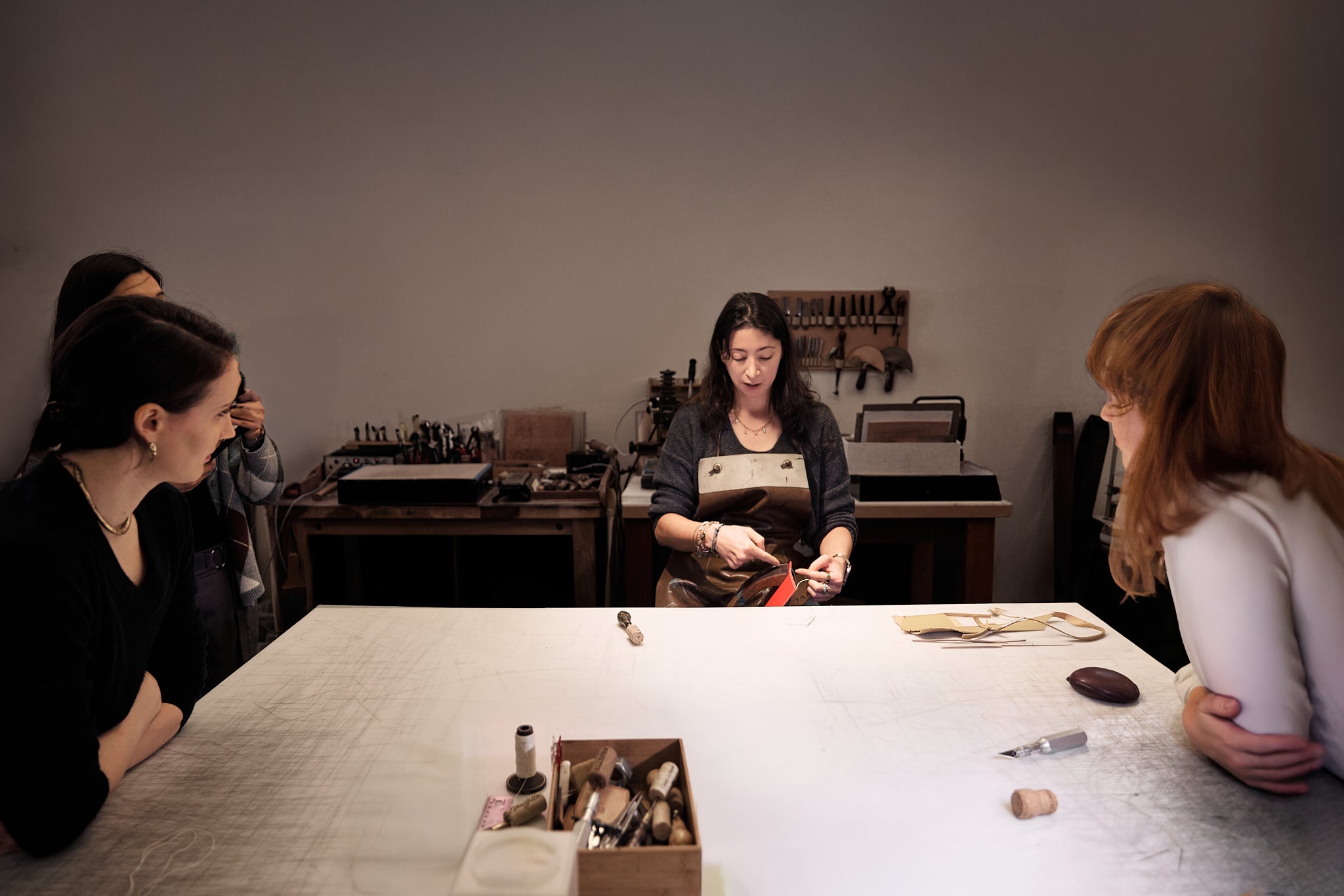
The question is not whether the class is worth the money. It is what you can do afterward that you could not do before.
A leather class is worth it if it teaches transferable technique rather than a single kit you assemble once. At Heirloom Leathercraft in San Francisco, you learn the fundamentals of fine leather working - saddlestitching, finishing and the full sequence of making an object well. Our program was developed by Hermès-trained Béatrice Amblard. The value is a skill you keep, not a souvenir. A one-day Introduction to the AMBLARD Method is $800.
What do you walk away able to do?
Before a good class, leather can be intimidating. You do not know how to cut it without wandering, how to mark even holes, or how to close a seam so it will last. After one, you can sit down with a piece of hide and a few tools and produce something that holds together and looks intentional.
That shift, from watching to doing, is the whole point. The measure of a class is not the object in your hands at the end of the day. It is what your hands can repeat the next week without anyone standing over them.
There is a simple test for whether a class was worth it. A week later, could you make something similar without the instructor in the room? If the answer is yes, you did not just buy an evening. You bought a skill, and skills compound.
What separates a real class from a kit night?
Many leather classes hand you a pre-cut kit and walk you through gluing and stitching it. You leave with a finished item and very little you can do again on your own. There is nothing wrong with an evening like that, but it is entertainment more than instruction.
A class built on technique teaches the underlying skills: reading the leather, cutting, skiving, edge finishing, and saddle stitching. Those skills carry to the next project and the one after that. That is the difference between spending an evening and learning a craft.
The tell is in what you leave with. A kit night leaves you with an item and an empty feeling the next time you face raw leather. A technique class leaves you with the sequence of decisions behind the item, which is the thing you can actually repeat.
Does who teaches it matter?
It matters more than almost anything else. Béatrice Amblard trained in Paris at the Chamber of Commerce and Industry of Paris and spent years at Hermès before founding her own atelier and, now, the school. She and her daughter, Amélie Amblard, teach the core program in person.
In-person instruction means a correction reaches you while the habit is still forming. A video cannot see that your awl is tilting or your tension is loose. A trained instructor at the bench can, and that early correction saves months of practicing the wrong thing.
How should you think about the cost?
The Introduction to the AMBLARD Method is $800 for a full day. Level 1: Foundations is $5,000. Put next to the price of a well-made leather bag, a class is not only the cost of an object, it is the ability to understand and make many.
Heirloom does not discount, and enrollment is open and rolling, so the decision is simply whether the skill is worth it to you, not whether to catch a sale or a deadline.
It also helps to reframe the comparison. The cost of a class is not the cost of the object you make that day. It is the cost of being able to make objects at all, and to judge quality in everything leather you buy for the rest of your life.
What do students say they got from it?
The reviews tend to describe more than technique. Adrien, a 2025 graduate, put it this way: "I've been taking leather-making classes with Bea and Amelie, and it's truly become a highlight of my week. Their expertise in traditional French leatherworking is remarkable, and their passion for the craft is contagious. But what makes this experience special goes beyond the skills I'm learning—it's the wonderful community that's formed here. After demanding weeks at work, this atelier has become my sanctuary. There's something deeply grounding about working with leather, learning alongside supportive people who share this interest, and creating something beautiful with my own hands. It's more than just a class; it's where I reconnect with myself and find balance."
That combination, real skill and a place to use it, is what most students point to when they say it was worth it.
Who is a leather class actually for?
It suits people who want to make things with their hands and are willing to be patient with a slow craft. You do not need an artistic background or a plan to sell what you make. Plenty of students come simply because the bench is a quiet, focused counterweight to the rest of their week.
If you are curious whether it fits you, the one-day Introduction answers that question honestly and inexpensively before you commit to more.
Frequently Asked Questions
Are leather classes worth it for a complete beginner?
Yes, if the class teaches technique rather than a one-time kit. The Introduction to the AMBLARD Method starts from the beginning and teaches the basics of leather working- pattern making, saddle stitching, finishing, for $800.
How much does a leather class cost at Heirloom?
The one-day Introduction is $800 and Level 1: Foundations is $5,000. Heirloom does not discount.
Will I make something in a beginner class?
Yes. You leave with a real piece you made, and more importantly with skills you can repeat on your own.
Do I need to buy tools before I start?
No. All tools are supplied for use in our studio. This allows you to begin with the Introduction and decide later whether to build your own at home tool kit as you continue.


